Chat with us, powered by LiveChat
Home > Corporate Data Backup > Enterprise Data Backup Tools > MariaDB Backup Software Solution

Bacula Enterprise’s MariaDB module backs up and recovers MariaDB environments faster, more securely, more efficiently, and with significantly less administrative overhead. MariaDB is a live database server, and in enterprise environments it processes read and write transactions continuously. As with any active database server, a backup taken while transactions are in progress will catch some of those transactions mid-write, and that incomplete data will render the backup unreliable and fragmented for recovery.

To that end, Bacula’s MariaDB module is built to back up a live MariaDB server without disrupting active transactions, with multiple approaches suited to different recovery time and performance requirements. Any backup administrator can run it without prior knowledge of complex scripts or MariaDB internals.

What Bacula’s MariaDB Module Supports

Bacula’s MariaDB module supports Dump and Binary backup techniques for high-transaction MariaDB environments. The module automatically backs up server-level data such as user definitions, global grants, and configuration files. Point In Time Recovery (PITR) is available in each mode, and the module supports object filtering during backup and restore operations.

For organizations running large, high-transaction-rate MariaDB databases, downtime brings transaction processing to a halt and cuts revenue directly. The longer the database stays offline, the greater the financial damage. Bacula’s MariaDB module was built specifically to minimize that window.

Faster MariaDB Recovery with the Prepare Step

With Bacula’s MariaDB Binary backup module, databases are restored to a temporary location before the live database is touched. Mariabackup’s Prepare step then applies redo log changes to that data and produces a fully consistent restore point. Only after that process completes does the actual modification of the live database can begin.

By default the Prepare step runs at restore time. Bacula can also run it automatically during the backup phase instead. When it runs during backup, the consistency processing is already complete before a recovery is ever triggered, and the restore can begin immediately without any preparation delay. For large organizations with tight RTOs, faster restores reduce downtime. Less downtime keeps the business operational and revenue flowing.

*The module works on both 32-bit and 64-bit Linux platforms.

Hot MariaDB Backup Tool Without Locks or Encryption Compromises

Bacula Enterprise’s MariaDB module integrates with Mariabackup (mariadb-backup), an open-source hot backup utility originally forked from Percona XtraBackup, to deliver fast, consistent backups of live MariaDB servers. Unlike Percona XtraBackup, Mariabackup handles encrypted and compressed MariaDB tables natively, which makes it the correct tool for modern MariaDB deployments where encryption is a standard requirement. Mariabackup eliminates the need to lock the database during backup, and active transactions continue without interruption. Mission-critical environments with tight Recovery Time Objectives (RTOs) can run backups without any impact on production traffic.

Key MariaDB Backup Software Benefits

Dual-Mode Backup Coverage

  • Flexible Backup Speed and Size Control – Dump mode generates plain-text SQL files per database and produces smaller backups suited to migrations and cross-version restores. Binary mode uses Mariabackup to copy data files directly, which produces faster backups and significantly faster restores for large production databases.
  • Dump and Binary Mode Combination – Dump and Binary strategies are not mutually exclusive. Each mode can run against the same MariaDB server simultaneously, and administrators can apply each mode where it fits best within a single backup policy.
  • Cross-Version Restore Support – Dump mode backups can be restored to a newer major version of MariaDB without modification. Restoring to a previous major version is possible but may require manual editing of the SQL file if the backup includes features not available in the older version.
  • Point-In-Time Recovery for Each ModePITR is available for Dump and Binary strategies alike, and the agent manages binary log files required to replay transactions to a precise recovery point.

Hot Backup Without Disruption

  • No Database Lock During Backup – Mariabackup backs up live MariaDB servers without locking the database, and active transactions continue without interruption.
  • Encrypted and Compressed Table Support – Mariabackup handles encrypted and compressed MariaDB tables natively, a capability that Percona XtraBackup does not support.
  • Prepare Step During Backup – The Prepare step runs automatically during the backup phase, and consistency processing is complete before a recovery is triggered.

Complete Backup Scope

  • Automatic Metadata Backup – Every backup job captures global grants, server settings, per-database schemas, creation scripts, and per-database user grants alongside the database data itself.
  • Single Database Restore – In Dump mode, individual databases can be restored independently without recovering the full server.
  • No Scripting Required – The agent handles all backup operations through Bacula’s interface without requiring MariaDB-specific scripts or knowledge of backup internals.

Every MariaDB Software Feature Explained

Bacula’s MariaDB Backup Software Coverage

  • Per-Database Dump Backup – The MariaDB agent dumps each database separately by default. Each dump is a plain-text SQL file containing every command needed to reconstruct that database to the exact state it was in at backup time.
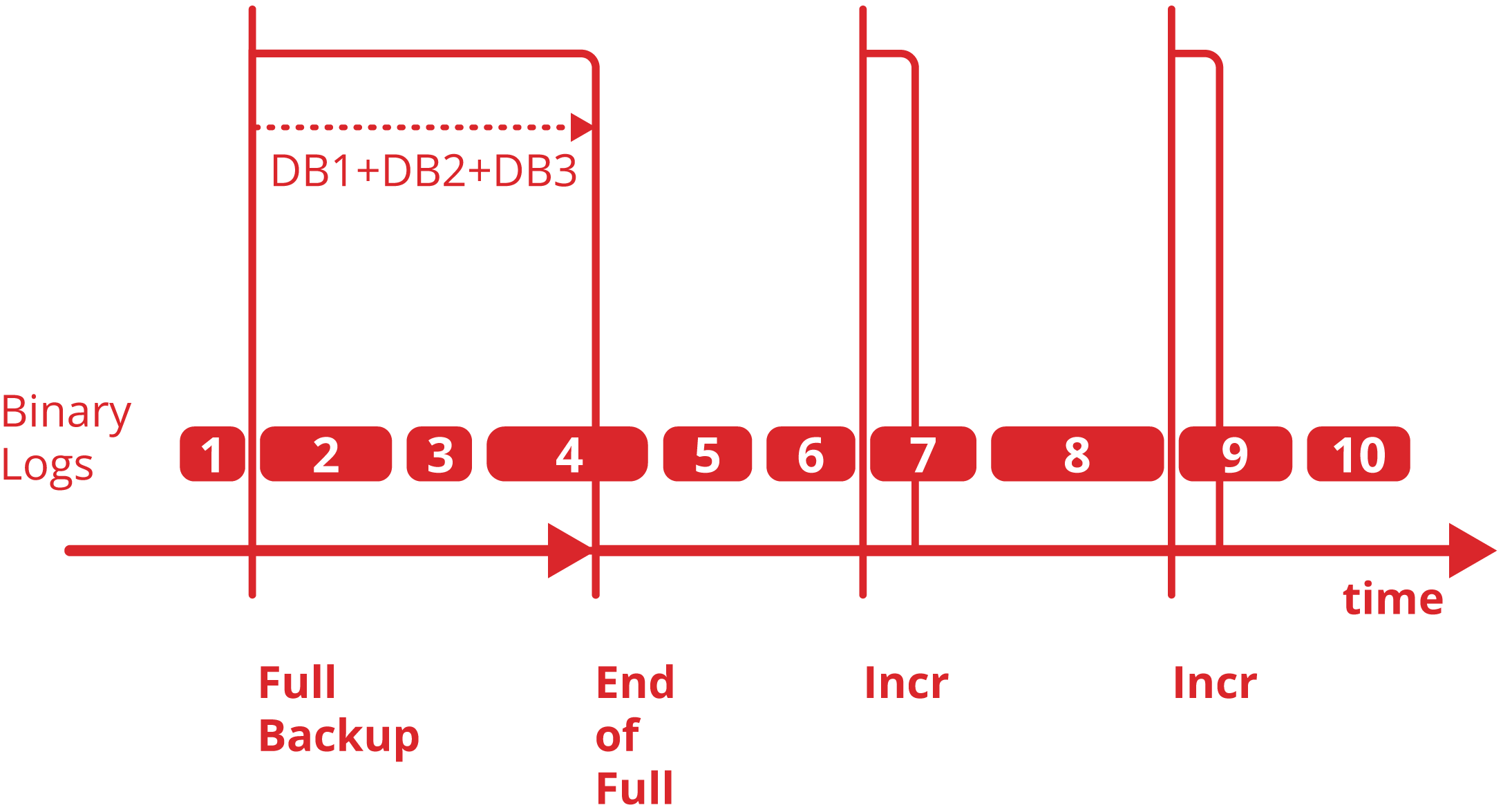
  • All-Databases Dump Backup – The all_databases option generates a single all-databases.sql file covering every database on the server in one operation. Binary logs generated before the job ends are included in the backup, and the next incremental job picks up from where the full backup left off.
  • Binary Backup via Mariabackup – Binary mode uses Mariabackup, an open-source hot backup utility originally forked from Percona XtraBackup 2.3.8. Mariabackup performs physical online backups of InnoDB, Aria, and MyISAM tables. It handles encrypted and compressed tables natively, runs without locking the database, and does not require large temporary files during the backup process.
  • Binary Log Backup – The MariaDB agent saves binary log files generated during every backup job. Binary logs record every database change event, including table creation operations, data modifications, and how long each statement took to execute. These logs are the foundation of Point-In-Time Recovery.
  • Incremental Backup – Each incremental job after a Full backup saves only the new binary logs generated since the previous job. The Accurate option prevents duplicate log files from appearing across backup sets and keeps restore chains clean.
  • Differential Backup – A differential job saves all binary logs generated since the last Full backup. Restoring from a differential requires only the Full backup and the differential, with no need to chain multiple incremental sets.
  • Online Backup – Dump and Binary modes run against a live MariaDB server. Neither mode requires the server to be taken offline or put into a maintenance state.
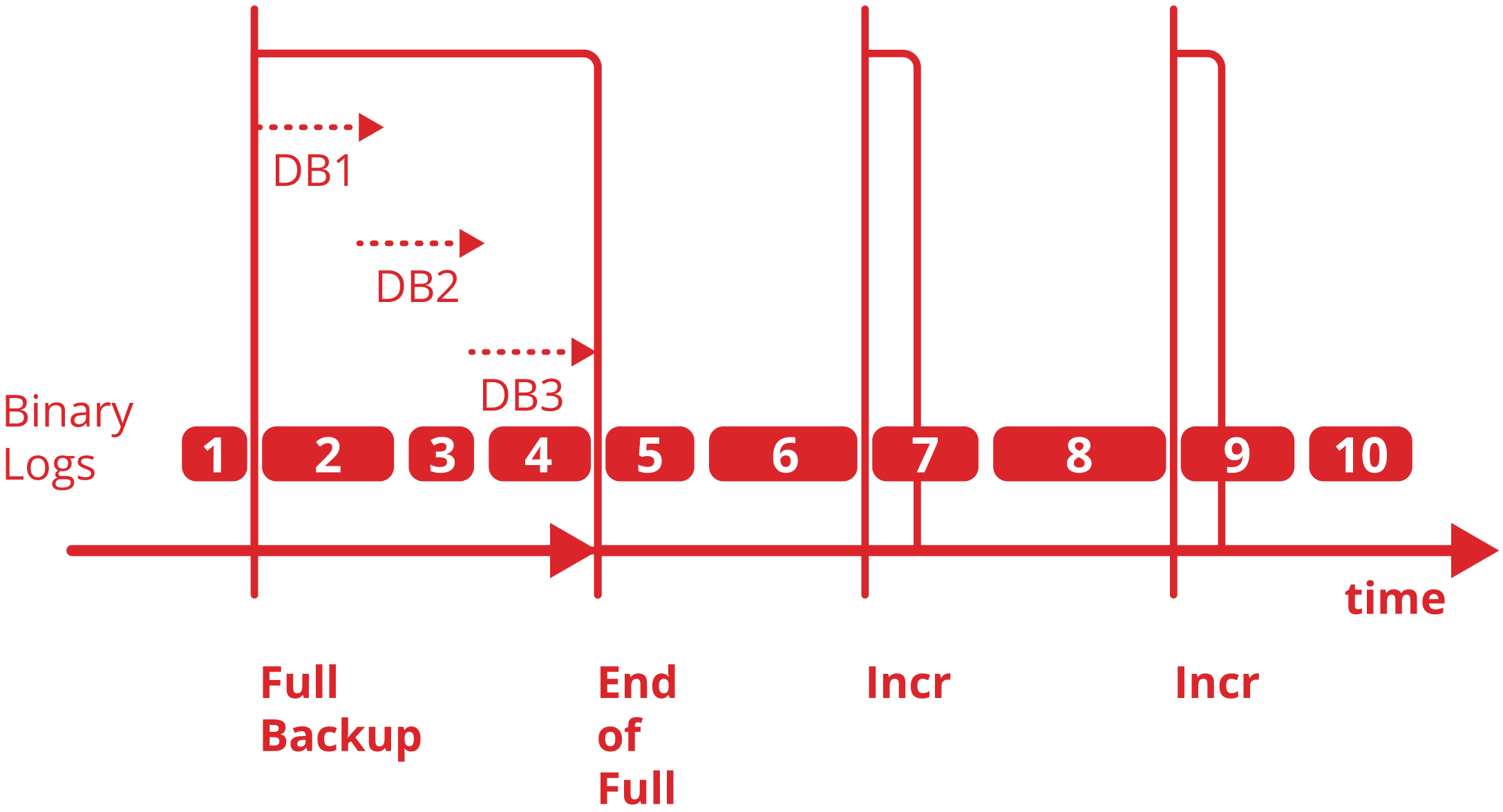
  • Globally Consistent Backup – In per-database dump mode, each database is consistent individually. The agent saves binary logs generated during the backup window, and those logs can be replayed to bring all databases to a consistent state at a specific point in time. Binary mode produces a globally consistent snapshot of the full server in a single pass.
  • Automatic Metadata Capture – Every backup job automatically captures the MariaDB server configuration file (my.cnf), current server variables (settings.txt), global grants covering all user accounts and their specific options, and per-database creation scripts, schemas, data files, and user grants.
  • Cross-Version Restore – Dump mode backups can be restored to a newer major version of MariaDB without modification. Restoring to a previous major version is possible but may require manual editing of the SQL file if the backup includes features not available in the older version. Binary mode backups do not support cross-version restores.

MariaDB Recovery Options

  • Point-In-Time Recovery – PITR is available in Dump and Binary modes. The MariaDB agent tracks and manages binary log files across full, incremental, and differential jobs, and replays those logs to recover the database to a precise point in time.
  • Single Database Restore – Dump mode stores each database in its own set of SQL files. Individual databases can be restored from those files without touching the rest of the server. A single table or schema object can also be recovered by editing the,locally restored, dump file directly.
  • Users and Roles Restore – Global grants and per-database user grants are stored as separate files in every backup job. Administrators can restore user accounts and permissions independently from database data.
  • Full Server Restore from Binary Mode – The Bacula agent uses Mariabackup to restore a complete MariaDB server from a binary backup. The server data is first restored to a temporary location. The Prepare step then brings that data to a fully consistent state before the live database is touched.
  • Prepare-at-Backup-Time – The Prepare step can run automatically during the backup phase rather than at restore time. When it does, the consistency processing is already done by the time a recovery is triggered, and the restore runs faster as a result.
  • Restore from Dumps or Binary Logs – Administrators can restore from SQL dump files or from Mariabackup binary backups. Both paths are available through Bacula’s restore interface depending on the recovery scenario.

MariaDB Backup Administration and Control Tool

  • Estimate Command – The estimate command queries the Bacula agent before any job runs and displays all databases found on the server. In Dump mode, the agent reports the database size rather than the estimated dump size, since the final dump size cannot be calculated before the job runs.
  • Automatic Database Discovery – The Bacula agent detects all databases on the server automatically. Specific databases can be targeted by name in the Fileset configuration without manual inventory work.
  • Object Filtering – Administrators can include or exclude specific databases and tables during backup and restore operations through plugin parameters. No manual editing of dump files is required.
  • Accurate Mode – Activating the Accurate option on incremental and differential jobs ensures that each binary log file appears only once across backup sets. Without it, the same log file could be included in multiple jobs, which creates ambiguity in restore chains.
  • mbstream Format – Mariabackup supports mbstream, a custom streaming format introduced to handle simultaneous compression and streaming. It is available alongside the standard TAR format.
  • Script-Free Operation – The Bacula agent handles all backup operations through Bacula’s interface. Administrators do not need to write MariaDB-specific scripts or understand the internals of Mariabackup to run it correctly.

How Bacula Enterprise Protects Your MariaDB Data

Bacula Enterprise is trusted by defense organizations, government agencies, and financial institutions to protect their most sensitive MariaDB environments. Security is built into the architecture itself. The File Daemon (backup client – Bacula agent) runs on each protected host and holds no credentials to access storage targets directly. Because the File Daemon has no path to the storage layer, a compromised MariaDB host cannot read, overwrite, modify, or delete backup data.

Ransomware and Malware Protection

  • Immutable Disk Volumes – Backup volumes can be set to immutable once written. No modification or deletion is possible after that point, including by privileged users.
  • Data Poisoning Detection – Bacula identifies corrupted or tampered data automatically before it propagates into the backup chain.
  • Advanced Ransomware Detection – BGuardian monitors backup activity for suspicious patterns. When abnormal behavior is detected, alerts fire before damage spreads.
  • Silent Data Corruption Detection – Bacula verifies the integrity of backed-up data independently of the source system. Corruption that the source system cannot see does not go undetected.

Encryption and Authentication

  • *Native Encrypted Table Backup – Mariabackup backs up encrypted MariaDB tables without decrypting them first. Backup data retains the same encryption state as the source tables throughout the backup process.
  • AES Encryption – Data encryption is configurable per client at AES 128, AES 192, or AES 256 at the volume level.
  • TLS for All Network Traffic – Every communication channel between Bacula components runs over TLS. SCRAM-SHA-256 password authentication operates between daemons.
  • Multi-Factor AuthenticationBWeb access supports MFA and OTP authentication with biometric smartphone support.
  • Active Directory and LDAP Integration – Access control connects directly to your existing identity management infrastructure. No parallel user management is required.

Compliance and Auditability

  • FIPS 140-3 Compliant – Bacula meets the federal cryptographic standards required by government and defense environments.
  • SHA256 and SHA512 File Signatures – Every backed-up file gets a cryptographic signature. Bacula’s catalog comparison works like Tripwire, and any deviation from the known state triggers a break-in alert.
  • SIEM Integration – Security events feed directly into your existing Security Information and Event Management platform.
  • Hardening Reports – Bacula generates per-host hardening reports for every system it runs on. Insecure configurations are surfaced before they become vulnerabilities.

What Every Bacula Enterprise Installation Includes

Bacula’s MariaDB backup software is part of a unified enterprise backup platform. Every capability listed below is available across all Bacula Enterprise installations, regardless of the environment or workload.

Backup Storage and Cost Control

Bacula Enterprise gives administrators direct control over storage costs through data reduction and flexible destination routing.

  • Block-Level Deduplication – Any data block that appears more than once across the backup catalog is written to storage only once. Storage consumption drops without any change to backup policy or schedule.
  • Adaptive Compression – Compression algorithms are configurable per job. Administrators tune compression based on data type and available resources.
  • Multiple Storage Target Types – Backups write to local disk, NAS, SAN, tape libraries, cloud object storage including S3, Azure, and Google Cloud, or any combination within a single policy.
  • S3-Compatible Object Storage – Bacula connects to any S3-compatible provider for long-term retention without vendor lock-in.
  • Tiered Storage Workflows – Backup data can be configured to move across storage tiers automatically as it ages. Frequently accessed recovery points stay on fast storage and older data shifts to lower-cost destinations.
  • Incremental Forever – After an initial full backup, every subsequent job captures only what has changed. Recurring full backup windows are no longer necessary.
  • Bandwidth-Conscious Transfers – Only modified data crosses the network between backup runs. Production network load stays low without manual throttling or scheduling workarounds.

Backup Security and Compliance

Security and regulatory compliance are built into every layer of the platform, from data transport and storage encryption to access control and audit logging.

  • AES-256 Encryption – AES-256 encryption covers the full data path from source client to final storage destination. Key management is configurable to fit organizational security policies.
  • Immutable Backup Copies – WORM-compatible storage locks backup data against modification or deletion once written. Ransomware and insider threats have no path to the recovery point.
  • Granular Access Controls – User permissions scope to specific jobs, restore workflows, and management functions. Each administrator accesses only what their role requires.
  • Complete Activity Auditing – Every backup, restore, and configuration change is logged with user identity and timestamp. Compliance and security teams get a full, unbroken audit trail.
  • Regulatory Framework Support – Platform controls map to GDPR, HIPAA, and SOC 2 requirements through encryption, configurable retention policies, and detailed audit logs.
  • Privacy-Preserving Architectures – Zero-knowledge deployment options allow backup infrastructure to run without granting administrators any visibility into the protected data.

Backup Management and Administration

Two complementary interfaces and a full suite of management tools provide visibility and control across all backup operations.

  • Dual Interface – BWeb provides a graphical console for day-to-day job management and monitoring. Bconsole (user agent) gives operators full command-line control for scripting, automation, and advanced configuration.
  • Scalability Without Limits – The same platform architecture manages environments from a handful of servers to deployments numbering in the thousands, all under a single management plane.
  • Tenant Isolation – MSPs and large enterprises partition the backup environment into independently administered units. Each unit has its own configuration, policies, and access controls.
  • Automatic Resource Discovery – The platform scans infrastructure to identify and catalog backup targets automatically. Protection coverage stays current as the environment grows.
  • Detailed Reporting – Scheduled reports cover job outcomes, capacity trends, compliance status, and operational performance on a defined cadence.
  • External System Integration – Bacula connects to monitoring tools, IT ticketing systems, and directory services including LDAP and Active Directory. No custom development is required.

Multi-Environment Backup Coverage

Physical servers, virtual machines, containers, and cloud infrastructure all fall within a single unified backup strategy.

  • Multi-Platform Virtualization – Native integration for VMware vSphere, Hyper-V, KVM, Red Hat Virtualization, Xen, Azure VM, Proxmox, and Nutanix AHV with consistent policy application across all platforms.
  • Physical and Virtual Convergence – Physical servers, workstations, and virtual machines are protected through the same management interface with unified backup policies.
  • Container and Cloud-Native Support – Full protection for Docker, Kubernetes, and OpenShift environments with persistent volume backups and application-consistent snapshots.
  • Multi-Cloud Storage Integration – Native support for public, private, and hybrid cloud storage including S3, S3-IA, Azure, Google Cloud, Oracle Cloud, and Glacier interfaces with Minimal Restore Cost (MRC) functionality
  • Database and Application Integration – Hot backup support for Oracle, SQL Server, MySQL, PostgreSQL, SAP HANA, and other mission-critical applications with full transactional consistency.

Predictable Backup Licensing

Licensing is based on environment size, not data volume. MariaDB databases can grow without triggering higher licensing costs.

  • Volume-Independent Licensing – Growing backup capacity does not increase license fees. Data protection costs stay flat as data volumes expand.
  • Predictable Cost Structure – A fixed pricing model lets teams plan infrastructure budgets without accounting for variable costs tied to storage growth or workload changes.
  • Workload-Agnostic Pricing – Database sizes, server counts, and storage volumes have no effect on licensing costs.
  • Large-Scale Cost Benefits – Organizations protecting large or rapidly growing MariaDB databases pay the same license fee regardless of how much data they add. The cost advantage over capacity-priced competitors grows as data volumes increase.
  • Service Provider Economics – MSPs take on clients with large or fast-growing datasets without absorbing licensing cost increases that erode margins under per-terabyte pricing models.

Recovery and Business Continuity

Every recovery scenario has a defined path, from single-file restores to full site rebuilds.

  • System-Level Bare Metal Restore – Bacula recovers a complete server from scratch including the operating system, applications, configuration, and data without requiring a prior manual installation.
  • Cross-Platform Data Movement – Backup data can be recovered to a different operating system than its source. Teams have options when like-for-like hardware is unavailable or a migration is underway.
  • Geographic Backup Replication – Backup sets are copied to geographically separate storage locations. A site-wide outage does not take recovery points down with it.
  • Frequent Backup Scheduling – Backup intervals can be reduced to minutes. The potential data loss window shrinks to minutes.
  • Automated Restore Validation – Recoverability is confirmed through automated testing without administrator involvement or a separate validation process.

Choosing Between Dump and Binary

Bacula’s MariaDB module supports two backup strategies, each suited to different recovery requirements. Binary mode uses Mariabackup to deliver fast backups and fast restores for large production servers.

Dump mode generates plain-text SQL files, and trades speed for portability, granular object-level recovery, and cross-version migration support. The two strategies are not mutually exclusive. Both can run against the same MariaDB server simultaneously within a single backup policy.

Feature Binary Dump
Backup size Big Small
Backup speed Fast Slow
Online backup Yes Yes
Backup consistency Yes Yes
Incremental and Differential support Yes Yes
Restore at any point in time (PITR) Yes Yes
Single object restore (table, schema) No Yes*
Restore to a newer major MariaDB version No Yes
Restore to a previous major MariaDB version No Yes**

* To restore a single object, the dump file must be edited manually.
** Restoring to a previous major version of MariaDB may require manual editing of the SQL file if the backup includes features not available in the older version. Restoring to a previous version is neither supported nor guaranteed.

Dump and Binary Backup Modes

Dump

Interaction between Backup and Binary LogsInteraction between Backup and Binary Logs

MariaDB constantly generates binary logs during a database’s life. These logs support Point In Time Recovery (PITR) and replication tasks. Bacula’s MariaDB dump mode backs up each database separately by default. When restoring an entire server with multiple databases, each database is consistent individually, but the databases are not backed up at exactly the same time, therefore the server is not globally consistent.

Bacula Enterprise’s MariaDB module saves the binary log files generated during each backup job. Those log files can be replayed later to bring the entire server to a consistent state at a specific point in time.

Interaction between all_databases option and Binary Logs

Interaction between all_databases option and Binary Logs

The all_databases option is for administrators who need a globally consistent snapshot of the entire server in a single operation. It dumps all databases on the server in a single operation, and absolute consistency is achieved from the start of the job. The module saves binary logs generated before the end of the full backup, and each subsequent incremental job captures the logs generated after the previous job completed.

Binary

Bacula’s MariaDB module uses Mariabackup to perform binary mode backups. Mariabackup is an open-source hot backup utility built specifically for MariaDB servers. Unlike Dump mode, which generates plain-text SQL files per database, Binary mode copies the actual data files from disk in a single pass. The database does not need to be locked during the backup, and Mariabackup produces a globally consistent snapshot of the full server. Restore speeds in Binary mode are significantly faster than Dump mode. That speed advantage makes Binary mode the correct choice for large production databases where Recovery Time Objectives (RTOs) are tight.

One Platform for Your Entire IT Environment

Bacula Enterprise is not limited to MariaDB. The same platform that backs up your MariaDB databases also covers Oracle, PostgreSQL, MySQL, MS SQL, SAP HANA, VMware, Hyper-V, Kubernetes, Docker, and more, all managed from a single interface. Licensing is based on environment size, not data volume. MariaDB databases can grow without triggering higher licensing costs.

Download TrialDownload MariaDB whitepaper

FAQ

Why does backing up a live MariaDB server require a dedicated backup tool?

Because a direct file copy of a live MariaDB server captures transactions that are only halfway written to disk. That incomplete data makes the backup unusable for recovery. A dedicated tool like Mariabackup produces a consistent backup without interrupting the server.

What are the advantages of Bacula’s MariaDB backup software?

(1) Hot backups without database locking, (2) Point In Time Recovery (PITR) in both Dump and Binary modes, (3) automatic metadata capture, (4) object filtering, (5) single database restore, (6) native support for encrypted and compressed tables, (7) and a Prepare step that runs during backup to cut restore time significantly.

What is the difference between Dump and Binary backup mode in MariaDB?

Dump mode generates plain-text SQL files. Backups are smaller and support single object restores and cross-version migrations, but restore speed is very slow. Binary mode copies data files directly from disk. Backups are larger but significantly faster to create and restore. Both modes can run against the same server simultaneously.

Can Bacula back up a MariaDB database without locking it?

Yes. Bacula uses Mariabackup in Binary mode to perform a hot physical backup. The database stays online and active transactions continue without interruption throughout the backup window.

Does Bacula’s MariaDB module support Point In Time Recovery?

Yes. PITR is available in both Dump and Binary modes. The agent manages binary log files automatically and replays them to a precise recovery point without manual log tracking.

Can Bacula restore a single MariaDB database without recovering the full server?

Yes, in Dump mode. Individual databases are stored in separate SQL files and can be restored independently. A single table or schema object can also be recovered by editing the dump file. Binary mode does not support single object restores.

Does Bacula’s MariaDB backup tool support incremental and differential backups?

Yes. Both Dump and Binary modes support incremental and differential backup levels. Incremental jobs capture only new binary logs since the previous job. Differential jobs capture all binary logs since the last Full backup.